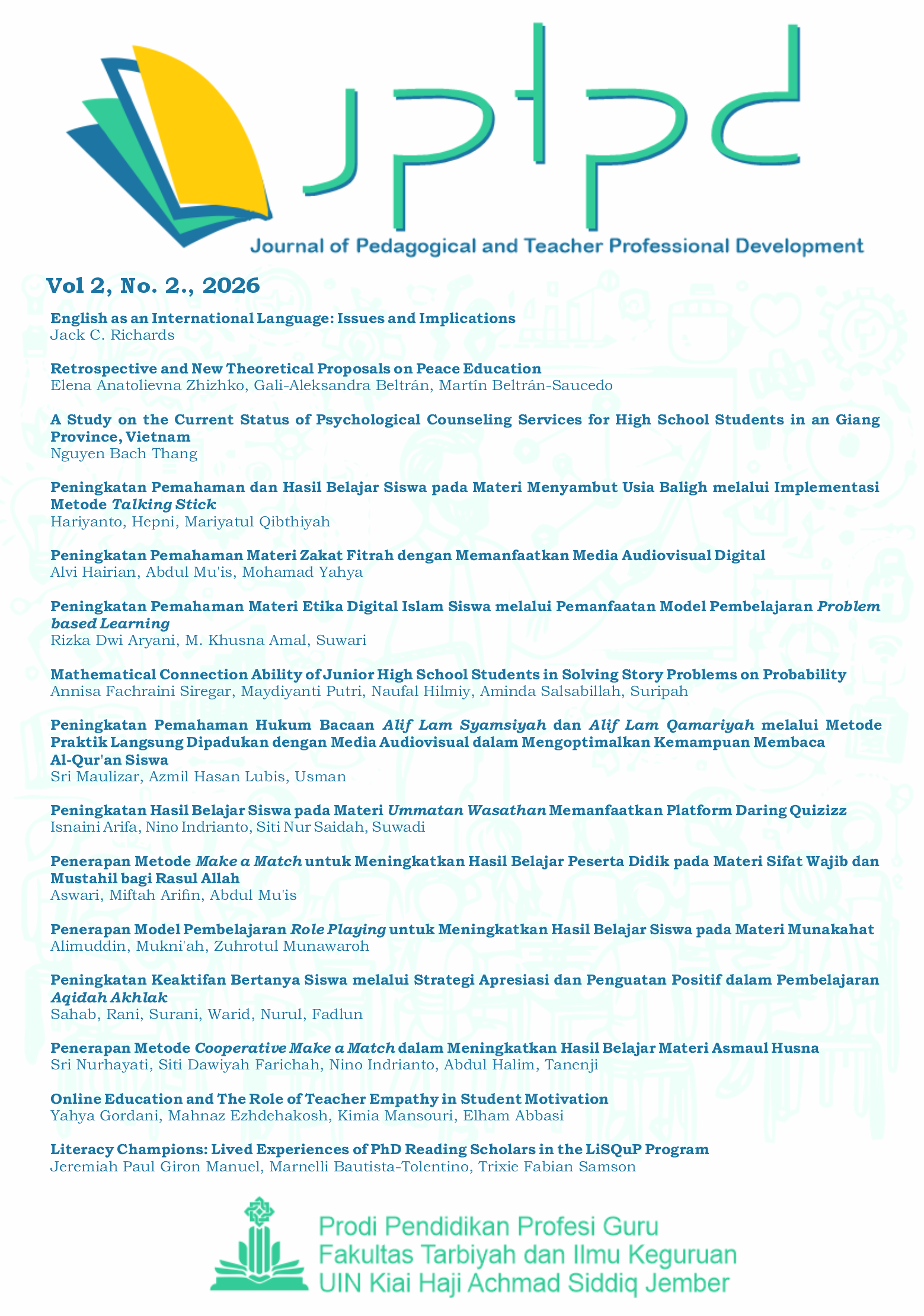
Peningkatan Pemahaman Materi Etika Digital Islam Siswa melalui Pemanfaatan Model Pembelajaran Problem based Learning
DOI:
https://doi.org/10.35719/jptpd.v2i2.137Keywords:
Etika Digital Islam, Model Pembelajaran, Penelitian Tindakan Kelas, Problem Based Learning, Classroom Action Research, Digital Ethics, Learning ModelAbstract
Penelitian ini bertujuan untuk meningkatkan pemahaman peserta didik terhadap materi etika digital dalam perspektif Islam melalui penerapan model pembelajaran Problem-Based Learning. Metode penelitian yang digunakan adalah penelitian tindakan kelas dengan model Kemmis dan McTaggart yang dilaksanakan dalam dua siklus. Setiap siklus terdiri atas tahap perencanaan, pelaksanaan, observasi, dan refleksi, dengan subjek penelitian sebanyak 36 siswa kelas XI SMK Negeri 5 Jember. Data dikumpulkan melalui observasi pembelajaran dan refleksi guru serta siswa. Hasil penelitian menunjukkan bahwa penerapan model PBL mampu meningkatkan keterlibatan dan pemahaman siswa. Pada siklus I, keterlibatan siswa berada pada kategori aktif dengan rata-rata skor 2,96 dari 4, sedangkan pemahaman materi etika digital Islam berada pada kategori baik dengan skor rata-rata 2,94 dari 4. Setelah dilakukan evaluasi dan perbaikan pada siklus II, keterlibatan siswa meningkat ke kategori sangat baik dengan rata-rata skor 3,52 dari 4, sementara pemahaman materi etika digital Islam juga meningkat menjadi kategori sangat baik dengan skor rata-rata 3,6 dari 4. Meskipun pada siklus I masih terdapat tantangan dalam manajemen waktu dan penyusunan argumen, refleksi dan perbaikan yang dilakukan pada siklus II berhasil meningkatkan partisipasi aktif siswa dan memperdalam pemahaman mereka terhadap prinsip etika digital Islam. Dengan demikian, penelitian ini menyimpulkan bahwa model Problem-Based Learning terbukti efektif dalam meningkatkan pemahaman siswa sekaligus keterlibatan mereka dalam proses pembelajaran.
This study aims to enhance students’ understanding of digital ethics from an Islamic perspective through the implementation of the Problem-Based Learning (PBL) model. The research employed a classroom action research design based on the Kemmis and McTaggart model, conducted in two cycles. Each cycle consisted of planning, implementation, observation, and reflection stages, involving 36 eleventh-grade students at SMK Negeri 5 Jember. Data were collected through classroom observations as well as teacher and student reflections. The findings indicate that the application of PBL successfully improved both student engagement and comprehension. In the first cycle, student engagement was categorized as active, with an average score of 2.96 out of 4, while their understanding of Islamic digital ethics was rated as good, with an average score of 2.94 out of 4. Following evaluation and refinement in the second cycle, student engagement increased to the very good category, with an average score of 3.52 out of 4, and their understanding of Islamic digital ethics also improved to the very good category, with an average score of 3.6 out of 4. Although challenges in time management and argument development were observed in the first cycle, reflection and adjustments in the second cycle led to significant improvements in active participation and a deeper understanding of Islamic digital ethics principles. This study concludes that the Problem-Based Learning model is effective in enhancing both students’ comprehension of Islamic digital ethics and their engagement in the learning process.
References
Almulla, M. A. (2020). The effectiveness of the project-based learning (PBL) approach as a way to engage students in learning. SAGE Open, 10(3), 2158244020938702. https://doi.org/10.1177/2158244020938702
Amalia, A. N., Alawiyah, F. S., & Agoro, S. (2025). Implementing the problem-based learning model to enhance critical thinking skills on the theme of environmental diversity in junior high school students. Journal of Pedagogical and Teacher Professional Development, 1(2), 336–351. https://doi.org/10.35719/jptpd.v1i2.243
Anggraini, A. P. D., Ul Haqq, A. D., Sa’ari, N. A. B., & Nasution, N. E. A. (2025). Implementation of the cooperative learning model type STAD (Student Team Achievement Division) to improve learning outcomes in Islamic religious education and character education. Journal of Pedagogical and Teacher Professional Development, 2(1), 193–202. https://doi.org/10.35719/jptpd.v2i1.931
Anshori, I. (2021). Problem-based learning remodelling using Islamic values integration and sociological research in madrasas. International Journal of Instruction, 14(2), 421–442. https://doi.org/10.29333/iji.2021.14224a
Ayub, S., & Ashraf, M. (2025). Exploring cyber deviant behaviors in young adults: A thematic content analysis. Journal of Psychology, Health and Social Challenges, 3(2), 41–48. https://doi.org/10.63075/zf98yp41
Firdaus, M. A. F., Supiana, U., Ruswandi, U., Erihadiana, M., & Taufik, O. A. (2024). Implementation of problem-based learning (PBL) in Islamic religious education (PAI) at higher education institutions to enhance students’ moderate attitudes. International Journal of Humanities Education and Social Sciences, 4(3). https://doi.org/10.55227/ijhess.v4i3.1253
Firdiansyah, F., & Hendrawati, T. (2023). Internalisasi nilai-nilai moderasi beragama dalam pembelajaran pendidikan agama Islam melalui model problem-based learning. At-Tajdid: Jurnal Pendidikan dan Pemikiran Islam, 7(2), 292–303. https://doi.org/10.24127/att.v7i2.2973
Ghani, A. S. A., Rahim, A. F. A., Yusoff, M. S. B., & Hadie, S. N. H. (2021). Effective learning behavior in problem-based learning: A scoping review. Medical Science Educator, 31(3), 1199–1211. https://doi.org/10.1007/s40670-021-01292-0
Gunawan, W., Farichah, S. D., & Halim, A. (2024). Peningkatan hasil belajar siswa pada materi keragaman melalui model problem-based learning di kelas IV SDN Sawahkulon Purwakarta. Journal of Pedagogical and Teacher Professional Development, 1(1), 134–146. https://doi.org/10.35719/jptpd.v1i1.27
Hmelo-Silver, C. E. (2004). Goals and strategies of a problem-based learning facilitator. Interdisciplinary Journal of Problem-Based Learning, 1(1). https://doi.org/10.7771/1541-5015.1004
Kemmis, S., & McTaggart, R. (1988). The action research planner. Deakin University Press.
Mardliyah, B. N., Pratiwi, I. S., & Amal, K. I. (2025, February). Safe internet at a young age: A digital safety guide for Mtsyappi Jetis students. In ACCEPT: Annual Conference on Community Engagement for Peaceful Transformation (Vol. 4, No. 1, pp. 45–53). https://conference.uin-suka.ac.id/index.php/accept/article/view/1704
Mas’ud, I. (2023). Penerapan nilai-nilai moderasi beragama dalam pembelajaran fiqih di PTKIS menggunakan konsep problem-based learning. Journal of Islamic Education and Learning, 3(1), 61–69. https://ejournal.stisdulamtim.ac.id/index.php/JIEL/article/view/87
Mawarni, S., & Jambeh, A. (2025). Improving student learning activities through the problem-based learning model in Islamic learning at SD Negeri Rantau Gedang. Journal of Indonesian Primary School, 2(1), 84–95. https://doi.org/10.62945/jips.v2i1.421
Muammar, M., Ruqoiyyah, S., & Ningsih, N. S. (2023). Implementing the teaching at the right level (TaRL) approach to improve elementary students' initial reading skills. Journal of Languages and Language Teaching, 11(4), 610–625. https://doi.org/10.33394/jollt.v11i4.8989
Nasution, N. E. A., Al Muhdhar, M. H. I., & Sari, M. S. (2023). Relationship between critical and creative thinking skills and learning achievement in biology with reference to educational level and gender. Journal of Turkish Science Education, 20(1), 66–83. https://doi.org/10.36681/tused.2023.005
Nurkhin, A., & Pramusinto, H. (2020). Problem-based learning strategy: Its impact on students' critical and creative thinking skills. European Journal of Educational Research, 9(3), 1141–1150. https://doi.org/10.12973/eu-jer.9.3.1141
Oktahariana, A., Zaini, Z. A. H., & Ilmi, A. F. (2024). Digital literacy in problem-based learning for Islamic religious education. International Journal of Graduate of Islamic Education, 6(1). https://doi.org/10.37567/ijgie.v6i1.3816
Rambe, D., Nasution, D., & Nasution, E. (2024). Efforts to increase student participation in Islamic education learning through the problem-based learning model at SD Negeri 0508 Tangga Bosi. Jurnal Profesi Guru Indonesia, 1(3), 85–91. https://doi.org/10.62945/jpgi.v1i3.402
Savery, J. R., & Duffy, T. M. (1995). Problem-based learning: An instructional model and its constructivist framework. Educational Technology, 35(5), 31–38.
Sugiyono, D. (2013). Metode penelitian pendidikan: Pendekatan kuantitatif, kualitatif dan R&D. Alfabeta.
Sukardi, A., Kholilurrohman, K., & Fathi, H. (2024). Enhancing critical thinking through problem-based learning in Islamic education. EDURELIGIA: Jurnal Pendidikan Agama Islam, 8(2). https://doi.org/10.33650/edureligia.v8i2.9071
Syaifudin, A., Heriawanto, B. K., Al-Abrori, M. A. A., & Humairoh, A. (2024). The influence of student's understanding of information and technology law on shaping character. Jurnal USM Law Review, 7(3), 1772–1783. https://doi.org/10.26623/julr.v7i3.10677
Trautman, L. J., Sanney, K. J., Yordy, E. D., Cowart, T. W., & Sewell, D. J. (2021). Teaching ethics and values in an age of rapid technological change. Rutgers Business Law Journal, 17(1), 17–74. https://papers.ssrn.com/sol3/papers.cfm?abstract_id=3102552
Trisiana, A. (2020). Digital literation models for character education in globalization era. Humanities & Social Sciences Reviews, 8(1), 22–31. https://doi.org/10.18510/hssr.2020.8164
Wahyu, Mustajab, Azaroh, S., & Baharun, H. (2025). Implementasi model problem-based learning untuk meningkatkan hasil belajar siswa pada materi larangan mengkonsumsi minuman keras. Journal of Pedagogical and Teacher Professional Development, 2(1), 122–139. https://doi.org/10.35719/jptpd.v2i1.115
Walters, M. G., Gee, D., & Mohammed, S. (2019). A literature review: Digital citizenship and the elementary educator. International Journal of Technology in Education, 2(1), 1–21. https://eric.ed.gov/?id=EJ1264251
Yusriani, Y. (2025). Problem-based learning model integrated with Islamic values on global warming material. ETDC: Indonesian Journal of Research and Educational Review, 4(4), 1280–1294. https://doi.org/10.51574/ijrer.v4i4.3791
Downloads
Published
How to Cite
Issue
Section
License
Copyright (c) 2025 Journal of Pedagogical and Teacher Professional Development

This work is licensed under a Creative Commons Attribution 4.0 International License.