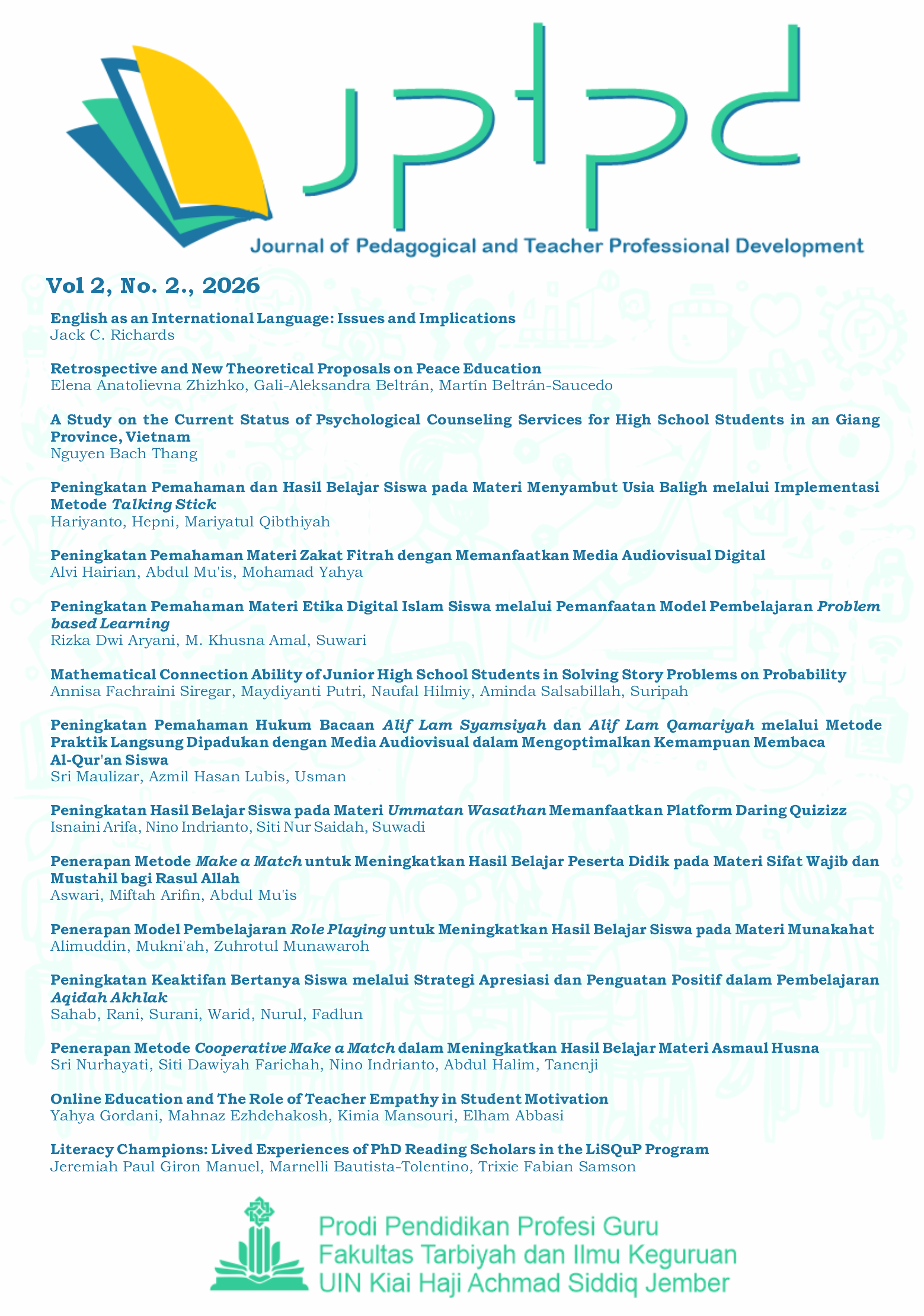
Online Education and The Role of Teacher Empathy in Student Motivation
DOI:
https://doi.org/10.35719/jptpd.v2i2.963Keywords:
Online Education, Student Motivation, Teacher EmpathyAbstract
Empathy has been recognized as one of the crucial elements in social and behavioral sciences. As a multidimensional phenomenon, empathy helps individuals share emotions and understand others’ emotional reactions. Online learning platforms, as one of the popular learning environments, should also be led with a proper pedagogy, regulating teachers to practice certain pedagogical practices to address students’ emotions and express emphatical responses. Nevertheless, it has often been reported that online learning due to social distancing and lack of certain psychological factors induces unfavorable results. Using a mixed-method research design, present study sought to take a serious look at the focal role of teacher empathy in pedagogical contexts and its effect on student motivation in online learning environments. To this aim, the Toronto empathy questionnaire was administered to ten university assistant professors at two universities. Simultaneously, a number of students of teacher participants (n=60) filled out the academic motivation scale. Student participants were also interviewed to reflect on the empathetical aspects of their teachers' performance in online classes. Findings from the quantitative (correlation and regression) analyses of the data as well as the qualitative analyses of the interviews, demonstrated that the explicit demonstration of empathy in classrooms elevates students' motivation for learning. The study highlights the importance of prioritizing the demonstration of empathy in educational ecology.
References
Arghode, V., Yalvac, B., & Liew, J. (2013). Teacher empathy and science education: A collective case study. Eurasia Journal of Mathematics, Science and Technology Education, 9(2), 89–99. https://doi.org/10.12973/eurasia.2013.921a
Aronson, E. (2000). Nobody left to hate: Teaching compassion after Columbine. Worth Publishers.
Atwood, J. B. (1998). The use of computer-based distance education in continuing education (Doctoral dissertation). University of Central Florida.
Barello, S., & Graffigna, G. (2020). Caring for health professionals in the COVID-19 pandemic emergency: Toward an “epidemic of empathy” in health-care. Frontiers in Psychology, 11, 1431. https://doi.org/10.3389/fpsyg.2020.01431
Beauchamp, C., & Thomas, L. (2009). Understanding teacher identity: An overview of issues in the literature and implications for teacher education. Cambridge Journal of Education, 39(2), 175–189. https://doi.org/10.1080/03057640902902252
Beard, L., Wilson, K., Morra, D., & Keelan, J. (2009). A survey of health-related activities on Second Life. Journal of Medical Internet Research, 11(2), e17. https://doi.org/10.2196/jmir.1192
Bloom, P. (2016). Against empathy: The case for rational compassion. Bodley Head.
Bond, M., Buntins, K., Bedenlier, S., Zawacki-Richter, O., & Kerres, M. (2020). Mapping research in student engagement and educational technology in higher education: A systematic evidence map. International Journal of Educational Technology in Higher Education, 17(1), Article 2. https://doi.org/10.1186/s41239-019-0176-8
Brent, L. J. N., Ruiz-Lambides, A., & Platt, M. L. (2017). Persistent social isolation reflects identity and social context but not maternal effects or early environment. Scientific Reports, 7, Article 17791. https://doi.org/10.1038/s41598-017-18104-4
Cochran-Smith, M., Feiman-Nemser, S., McIntyre, D. J., & Demers, K. E. (Eds.). (2008). Handbook of research on teacher education: Enduring questions in changing contexts (3rd ed.). Routledge.
Cooper, B. (2004). Empathy, interaction and caring: Teachers' roles in a constrained environment. Pastoral Care in Education, 22(3), 12–21. https://doi.org/10.1111/j.0264-3944.2004.00391.x
Decety, J., & Jackson, P. L. (2006). A social-neuroscience perspective on empathy. Current Directions in Psychological Science, 15(2), 54–58. https://doi.org/10.1111/j.0963-7214.2006.00406.x
Decety, J., & Lamm, C. (2007). The role of the right temporoparietal junction in social interaction: How low-level computational processes contribute to meta-cognition. The Neuroscientist, 13(6), 580–593. https://doi.org/10.1177/1073858407304654
Decety, J., & Lamm, C. (2011). Empathy versus personal distress: Recent evidence from social neuroscience. In J. Decety & W. Ickes (Eds.), The social neuroscience of empathy (pp. 199–213). MIT Press.
Delahunty, J., Verenikina, I., & Jones, P. (2014). Socio-emotional connections: Identity, belonging and learning in online interactions. A literature review. Technology, Pedagogy and Education, 23(2), 243–265. https://doi.org/10.1080/1475939X.2013.813405
Durkheim, E. (1951). Suicide: A study in sociology (J. A. Spaulding & G. Simpson, Trans.). Free Press. (Original work published 1897)
Ellis, K. (2004). The impact of perceived teacher confirmation on receiver apprehension, motivation, and learning. Communication Education, 53(1), 1–20. https://doi.org/10.1080/0363452032000135742
Emanuel, E. J. (2020). The inevitable reimagining of medical education. JAMA, 323(12), 1127–1128. https://doi.org/10.1001/jama.2020.1227
Evans, T. M., Bira, L., Gastelum, J. B., Weiss, L. T., & Vanderford, N. L. (2018). Evidence for a mental health crisis in graduate education. Nature Biotechnology, 36(3), 282–284. https://doi.org/10.1038/nbt.4089
Foster, S. (2021). Finding the right leadership style. British Journal of Nursing, 30(1), 83. https://doi.org/10.12968/bjon.2021.30.1.83
Fuchs, T. (2019). Empathy, group identity, and the mechanisms of exclusion: An investigation into the limits of empathy. Topoi, 38(1), 239–250. https://doi.org/10.1007/s11245-016-9408-2
García-Pérez, R., Santos-Delgado, J.-M., & Buzón-García, O. (2016). Virtual empathy as digital competence in education 3.0. International Journal of Educational Technology in Higher Education, 13(1), Article 30. https://doi.org/10.1186/s41239-016-0029-7
Gkonou, C., & Mercer, S. (2017). Understanding emotional and social intelligence among English language teachers. British Council ELT Research Papers, 17(1), 1–20.
Güroğlu, B., Haselager, G. J. T., Van Lieshout, C. F. M., Takashima, A., Rijpkema, M., & Fernández, G. (2008). Why are friends special? Implementing a social interaction simulation task to probe the neural correlates of friendship. NeuroImage, 39(2), 903–910. https://doi.org/10.1016/j.neuroimage.2007.09.007
Heyes, C. (2018). Empathy is not in our genes. Neuroscience & Biobehavioral Reviews, 95, 499–507. https://doi.org/10.1016/j.neubiorev.2018.11.001
Hirn, S. L., Thomas, J., & Zoelch, C. (2019). The role of empathy in the development of social competence: A study of German school leavers. International Journal of Adolescence and Youth, 24(4), 395–407. https://doi.org/10.1080/02673843.2018.1548361
Hodges, C., Moore, S., Lockee, B., Trust, T., & Bond, A. (2020). The difference between emergency remote teaching and online learning. EDUCAUSE Review. https://er.educause.edu/articles/2020/3/the-difference-between-emergency-remote-teaching-and-online-learning
Hogan, R. (1969). Empathy: A conceptual and psychometric analysis. The Counseling Psychologist, 5(2), 18–26. https://doi.org/10.1177/001100006900500202
Hougaard, R., Carter, J., & Hobson, N. (2020). Compassionate leadership is necessary but insufficient. Harvard Business Review Digital Articles, 1–8. https://hbr.org/2020/04/compassionate-leadership-is-necessary-but-not-sufficient
Huber, J. (2012). Intercultural competence for all: Preparation for living in a heterogeneous world (Vol. 2). Council of Europe Publishing. https://rm.coe.int/intercultural-competence-for-all/16808ce20c
Jakovljevic, M. (2018). Empathy, sense of coherence and resilience: Bridging personal, public and global mental health and conceptual synthesis. Psychiatria Danubina, 30(4), 380–384. https://hrcak.srce.hr/211808
Jones, E. E. (1990). Interpersonal perception. W. H. Freeman.
Joseph, E. (2007). The scientific base linking social and emotional learning to school success. Journal of Educational & Psychological Consultation, 17(2–3), 191–210. https://doi.org/10.1080/10474410701413145
Konrath, S. H., O’Brien, E. H., & Hsing, C. (2011). Changes in dispositional empathy in American college students over time: A meta-analysis. Personality and Social Psychology Review, 15(2), 180–198. https://doi.org/10.1177/1088868310377395
Kresovich, A. (2022). The influence of pop songs referencing anxiety, depression, and suicidal ideation on college students’ mental health empathy, stigma, and behavioral intentions. Health Communication, 37(5), 617–627. https://doi.org/10.1080/10410236.2020.1866716
Kumar, A., & Nayar, K. R. (2021). COVID-19 and its mental health consequences. Journal of Mental Health, 30(1), 1–2. https://doi.org/10.1080/09638237.2021.1875412
Landers, M., Hegarty, J., Saab, M. M., Savage, E., Cornally, N., Drennan, J., & Coffey, A. (2020). Nurses’ and midwives’ views of the “Leaders for Compassionate Care Program”: A qualitative analysis. Collegian, 27(1), 2–10. https://doi.org/10.1016/j.colegn.2019.03.005
Leeman, Y., & Ledoux, G. (2005). Teachers on intercultural education. Teachers and Teaching: Theory and Practice, 11(6), 575–589. https://doi.org/10.1080/13450600500238463
Lewiński, M., & Mohammed, D. (2016). Argumentation theory. In K. B. Jensen, R. T. Craig, J. D. Pooley, & E. W. Rothenbuhler (Eds.), The international encyclopedia of communication theory and philosophy (pp. 1–15). Wiley-Blackwell. https://doi.org/10.1002/9781118766804.wbiect015
Lucchetti, G., Damiano, R. F., DiLalla, L. F., Lucchetti, A. L. G., Moutinho, I. L. D., da Silva Ezequiel, O., & Dorsey, J. K. (2018). Cross-cultural differences in mental health, quality of life, empathy, and burnout between US and Brazilian medical students. Academic Psychiatry, 42(1), 62–67. https://doi.org/10.1007/s40596-017-0805-1
Macfarlane, J. (2020). Positive psychology: Social connectivity and its role within mental health nursing. British Journal of Mental Health Nursing, 9(2), 1–12. https://doi.org/10.12968/bjmh.2020.9.2.1
Mazer, J. P. (2013). Associations among teacher communication behaviors, student interest, and engagement: A validity test. Communication Education, 62(1), 86–96. https://doi.org/10.1080/03634523.2012.731513
McAlinden, M. (2018). English language teachers' conceptions of intercultural empathy and professional identity: A critical discourse analysis. Australian Journal of Teacher Education, 43(10), 41–59. https://doi.org/10.14221/ajte.2018v43n10.3
McAlinden, M. L. (2012). Beyond understanding: Intercultural teacher empathy in the teaching of English as an additional language [Doctoral dissertation, University of Western Australia]. University of Western Australia Research Repository. https://research-repository.uwa.edu.au/en/publications/beyond-understanding-intercultural-teacher-empathy-in-the-teachin
McCroskey, J. C., & McCroskey, L. L. (1985). The affinity-seeking of classroom teachers. Communication Research Reports, 2(1), 20–26. https://doi.org/10.1080/08824098509359819
McDevitt, T. M., Lennon, R., & Kopriva, R. J. (1991). Adolescents’ perceptions of mothers’ and fathers’ prosocial actions and empathic responses. Youth & Society, 22(3), 387–409. https://doi.org/10.1177/0044118X91022003005
Menec, V. H. (2017). Conceptualizing social connectivity in the context of age-friendly communities. Journal of Housing for the Elderly, 31(2), 99–116. https://doi.org/10.1080/02763893.2017.1309937
Meyers, S., Rowell, K., Wells, M., & Smith, B. C. (2019). Teacher empathy: A model of empathy for teaching for student success. College Teaching, 67(3), 160–168. https://doi.org/10.1080/87567555.2019.1579699
Miller, F., & Wallis, J. (2011). Social interaction and the role of empathy in information and knowledge management: A literature review. Journal of Education for Library and Information Science, 52(2), 122–132. https://doi.org/10.2307/23006365
Miller, K. I., & Koesten, J. (2008). Financial feeling: An investigation of emotion and communication in the workplace. Journal of Applied Communication Research, 36(1), 8–32. https://doi.org/10.1080/00909880701799714
Naciri, A., Radid, M., Kharbach, A., & Chemsi, G. (2021). E-learning in health professions education during the COVID-19 pandemic: A systematic review. Journal of Educational Evaluation for Health Professions, 18, Article 27. https://doi.org/10.3352/jeehp.2021.18.27
Nurullah, A. S. (2012). Received and provided social support: A review of current evidence and future directions. American Journal of Health Studies, 27(3), 173–188.
O’Connor, K. E. (2008). “You choose to care”: Teachers, emotions and professional identity. Teaching and Teacher Education, 24(1), 117–126. https://doi.org/10.1016/j.tate.2006.11.008
Oruh, E. S., Mordi, C., Dibia, C. H., & Ajonbadi, H. A. (2021). Exploring compassionate managerial leadership style in reducing employee stress level during COVID-19 crisis: The case of Nigeria. Employee Relations, 43(6), 1362–1381. https://doi.org/10.1108/ER-06-2020-0302
Pachucki, M. C., Ozer, E. J., Barrat, A., & Cattuto, C. (2015). Mental health and social networks in early adolescence: A dynamic study of objectively-measured social interaction behaviors. Social Science & Medicine, 125, 40–50. https://doi.org/10.1016/j.socscimed.2014.04.015
Pantic, I. (2014). Online social networking and mental health. Cyberpsychology, Behavior, and Social Networking, 17(10), 652–657. https://doi.org/10.1089/cyber.2014.0070
Park, M.-H. (2014). Increasing English language learners' engagement in instruction through emotional scaffolding. Multicultural Education, 22(1), 20–29.
Perissinotto, C., Holt-Lunstad, J., Periyakoil, V. S., & Covinsky, K. (2019). A practical approach to assessing and mitigating loneliness and isolation in older adults. Journal of the American Geriatrics Society, 67(4), 657–662. https://doi.org/10.1111/jgs.15746
Pfeil, U., & Zaphiris, P. (2007). Patterns of empathy in online communication. Proceedings of the SIGCHI Conference on Human Factors in Computing Systems, 919–928. https://doi.org/10.1145/1240624.1240763
Pidbutska, N., Demidova, Y., & Knysh, A. (2021). Gender aspects of empathy in online learning of adolescents. Journal of Education Culture and Society, 12(1), 314–321. https://doi.org/10.15503/jecs2021.1.314.321
Ren, S.-Y., Gao, R.-D., & Chen, Y.-L. (2020). Fear can be more harmful than the severe acute respiratory syndrome coronavirus 2 in controlling the coronavirus disease 2019 epidemic. World Journal of Clinical Cases, 8(4), 652–657. https://doi.org/10.12998/wjcc.v8.i4.652
Riess, H. (2018). The empathy effect: Seven neuroscience-based keys for transforming the way we live, love, work, and connect across differences. Sounds True.
Schwenk, T. L. (2018). Physician well-being and the regenerative power of caring. JAMA, 319(15), 1543–1544. https://doi.org/10.1001/jama.2018.2115
Rook, K. S. (1984). The negative side of social interaction: Impact on psychological well-being. Journal of Personality and Social Psychology, 46(5), 1097–1108. https://doi.org/10.1037/0022-3514.46.5.1097
Rubin, G. J., & Wessely, S. (2020). The psychological effects of quarantining a city. BMJ, 368, m313. https://doi.org/10.1136/bmj.m313
Santamaría-García, H., Baez, S., García, A. M., Flichtentrei, D., Prats, M., Mastandueno, R., Sigman, M., Matallana, D., Cetkovich, M., & Ibáñez, A. (2017). Empathy for others’ suffering and its mediators in mental health professionals. Scientific Reports, 7(1), 1–13. https://doi.org/10.1038/s41598-017-05380-3
Santini, Z. I., Koyanagi, A., Tyrovolas, S., Mason, C., & Haro, J. M. (2015). The association between social relationships and depression: A systematic review. Journal of Affective Disorders, 175, 53–65. https://doi.org/10.1016/j.jad.2014.12.049
Schwartzman, R. (2020). Performing pandemic pedagogy. Communication Education, 69(4), 502–517. https://doi.org/10.1080/03634523.2020.1804602
Schwartzstein, R. M., & Roberts, D. H. (2017). Saying goodbye to lectures in medical school—Paradigm shift or passing fad? New England Journal of Medicine, 377(7), 605–607. https://doi.org/10.1056/NEJMp1706474
Scott, D. A., Valley, B., & Simecka, B. A. (2017). Mental health concerns in the digital age. International Journal of Mental Health and Addiction, 15(3), 604–613. https://doi.org/10.1007/s11469-017-9768-0
Shapiro, S. (2010). Revisiting the teachers' lounge: Reflections on emotional experience and teacher identity. Teaching and Teacher Education, 26(3), 616–621. https://doi.org/10.1016/j.tate.2009.09.009
Sharma, A., Miner, A. S., Atkins, D. C., & Althoff, T. (2020). A computational approach to understanding empathy expressed in text-based mental health support. arXiv preprint arXiv:2009.08441. https://arxiv.org/abs/2009.08441
Singer, T., & Klimecki, O. M. (2014). Empathy and compassion. Current Biology, 24(18), R875–R878. https://doi.org/10.1016/j.cub.2014.06.054
Smith, K. P., & Christakis, N. A. (2008). Social networks and health. Annual Review of Sociology, 34, 405–429. https://doi.org/10.1146/annurev.soc.34.040507.134601
Smith, M. L., Steinman, L. E., & Casey, E. A. (2020). Combatting social isolation among older adults in a time of physical distancing: The COVID-19 social connectivity paradox. Frontiers in Public Health, 8, 403. https://doi.org/10.3389/fpubh.2020.00403
Spreng, R. N., McKinnon, M. C., Mar, R. A., & Levine, B. (2009). The Toronto Empathy Questionnaire: Scale development and initial validation of a factor-analytic solution to multiple empathy measures. Journal of Personality Assessment, 91(1), 62–71. https://doi.org/10.1080/00223890802484381
Spreng, R. N., McKinnon, M. C., Mar, R. A., & Levine, B. (2009). The Toronto Empathy Questionnaire: Scale development and initial validation of a factor-analytic solution to multiple empathy measures. Journal of Personality Assessment, 91(1), 62–71. https://doi.org/10.1080/00223890802484381
Taylor, R., Thomas-Gregory, A., & Hofmeyer, A. (2020). Teaching empathy and resilience to undergraduate nursing students: A call to action in the context of COVID-19. Nurse Education Today, 94, 104524. https://doi.org/10.1016/j.nedt.2020.104524
Terry, C., & Cain, J. (2016). The emerging issue of digital empathy. American Journal of Pharmaceutical Education, 80(4), Article 58. https://doi.org/10.5688/ajpe80458
Tettegah, S., & Anderson, C. J. (2007). Pre-service teachers’ empathy and cognitions: Statistical analysis of text data by graphical models. Contemporary Educational Psychology, 32(1), 48–82. https://doi.org/10.1016/j.cedpsych.2006.10.002
Thoits, P. A. (1983). Multiple identities and psychological well-being: A reformulation and test of the social isolation hypothesis. American Sociological Review, 48(2), 174–187. https://doi.org/10.2307/2095103
Titsworth, S., Quinlan, M. M., & Mazer, J. P. (2010). Emotion in teaching and learning: Development and validation of the Classroom Emotions Scale. Communication Education, 59(4), 431–452. https://doi.org/10.1080/03634521003746156
Tough, H., Siegrist, J., & Fekete, C. (2017). Social relationships, mental health and wellbeing in physical disability: A systematic review. BMC Public Health, 17, Article 414. https://doi.org/10.1186/s12889-017-4308-6
Vallerand, R. J., Pelletier, L. G., Blais, M. R., Brière, N. M., Sénécal, C., & Vallières, É. F. (1992). The Academic Motivation Scale: A measure of intrinsic, extrinsic, and amotivation in education. Educational and Psychological Measurement, 52(4), 1003–1017. https://doi.org/10.1177/0013164492052004025
Van Veen, K., & Sleegers, P. (2006). How does it feel? Teachers' emotions in a context of change. Journal of Curriculum Studies, 38(1), 85–111. https://doi.org/10.1080/00220270500109304
Vogus, T. J., McClelland, L. E., Lee, Y. S. H., McFadden, K. L., & Hu, X. (2020). Creating a compassion system to achieve efficiency and quality in health care delivery. Journal of Service Management, 32(4), 560–580. https://doi.org/10.1108/JOSM-05-2019-0132
Waks, L. J. (2011). John Dewey on listening and friendship in school and society. Educational Theory, 61(2), 191–205. https://doi.org/10.1111/j.1741-5446.2011.00397.x
Warren, C. A., & Hotchkins, B. K. (2015). Teacher education and the enduring significance of “false empathy”. The Urban Review, 47(2), 266–292. https://doi.org/10.1007/s11256-014-0292-7
Wills, G., & Hofmeyr, H. (2019). Academic resilience in challenging contexts: Evidence from township and rural primary schools in South Africa. International Journal of Educational Research, 98, 192–205. https://doi.org/10.1016/j.ijer.2019.08.001
Yin, H.-B., & Lee, J. C.-K. (2012). Be passionate, but be rational as well: Emotional rules for Chinese teachers’ work. Teaching and Teacher Education, 28(1), 56–65. https://doi.org/10.1016/j.tate.2011.07.002
Zaky, H. (2022). Emotional intelligence and professional development: The impact of affective competence on teacher performance. In A. El-Amin (Ed.), Implementing diversity, equity, inclusion, and belonging in educational management practices (pp. 174–202). IGI Global. https://doi.org/10.4018/978-1-6684-4803-8.ch009
Zaky, H. (2023). Feedback effectiveness in higher education: Utilizing students’ feedback to foster teaching and learning. SSRN. https://doi.org/10.2139/ssrn.4505733
Zaky, H. (2024). Adult education and empathy: The impact of empathy development on students' academic competencies and classroom engagement post COVID-19. International Journal of Curriculum Development and Learning Measurement, 5(1), 1–18.
Zembylas, M. (2003). Caring for teacher emotion: Reflections on teacher self-development. Studies in Philosophy and Education, 22(2), 103–125. https://doi.org/10.1023/A:1022293304066
Downloads
Published
How to Cite
Issue
Section
License
Copyright (c) 2025 Journal of Pedagogical and Teacher Professional Development

This work is licensed under a Creative Commons Attribution 4.0 International License.